Why Shared Accounts Make Security Harder Than It Needs to Be
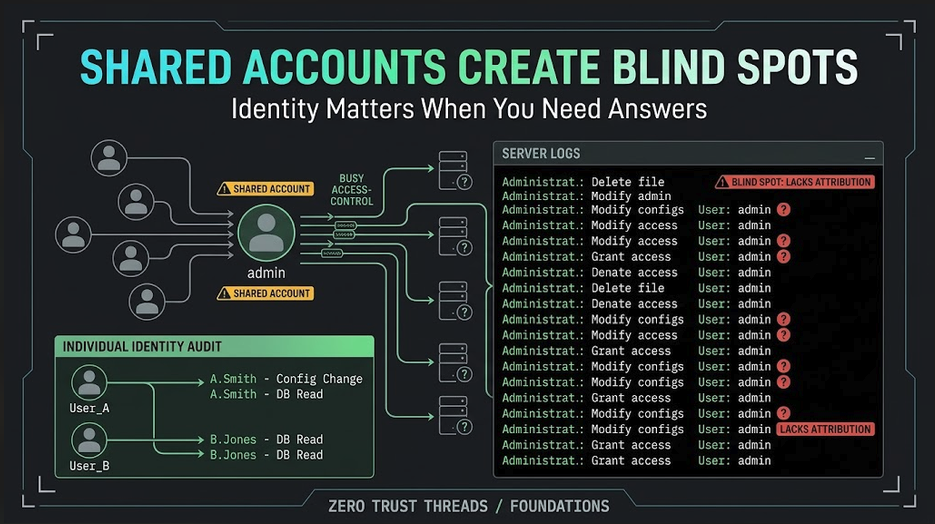
The Problem with Shared Accounts
A team needs access to a system. Someone creates:
admin
Then everyone uses it. Simple. Convenient. And now nobody knows who actually did anything.
Shared accounts can solve an immediate operational problem while creating several security problems behind it. Identity is useful because it connects actions to people or processes. When everyone becomes the same identity, that connection starts disappearing.
What Is a Shared Account?
A shared account is an account used by multiple people. Examples might include:
admin
helpdesk
operations
warehouse
support
Several employees know the same password. Everyone signs in using the same identity. The system sees: admin changed configuration.
But which administrator? That may be difficult to determine.
Accountability Gets Weaker
Suppose a configuration changes at 2:15 PM. The log says:
User:
admin
Action: firewall rule modified
Five people know the admin password. Who changed it? Maybe someone remembers. Maybe ticket history helps. Maybe another system provides additional evidence. But the identity itself does not answer the question.
Unique identities make logging much more useful. Instead of
admin
you can see:
alex.admin
sam.admin
taylor.admin
Now events can be connected to a specific identity.
Logging Is Only as Useful as the Identity Behind It
Logs can tell you:
What happened
When it happened
Which account performed the action
But if the same account represents ten people, part of the investigative value disappears. This matters during:
Incident response
Troubleshooting
Change review
Audit
Access review
Insider-threat investigations
The problem is not merely compliance. It is operational visibility.
Shared Passwords Create Another Problem
How do you rotate a shared password? Suppose six employees know it. One leaves the company. Now what?
You need to:
Change the password.
Distribute the new password.
Make sure every authorized user receives it.
Make sure the former employee no longer has it.
Update any systems or automation depending on it.
In practice, organizations sometimes avoid changing shared credentials because too many things depend on them. That is how stale credentials survive.
Offboarding Becomes Harder
With individual accounts, a user leaves. Their account can be disabled.
With shared accounts, the person's knowledge of the credential may remain useful until the shared credential is rotated. This makes account lifecycle management harder.
Note: NIST SP 800-171 Rev. 3 requires organizations within its scope to manage system accounts, define permitted account types, monitor account use, and disable accounts that are expired, inactive, no longer associated with a user, or otherwise no longer appropriate. Its discussion specifically notes that organizations may prohibit some group account types because they can increase risk.
The broader lesson applies well outside CUI environments: Know who has access and remove it when they no longer need it.
Shared Accounts Can Hide Privilege
Suppose five people share an administrator account. Do all five need administrator privileges? Maybe. Maybe not.
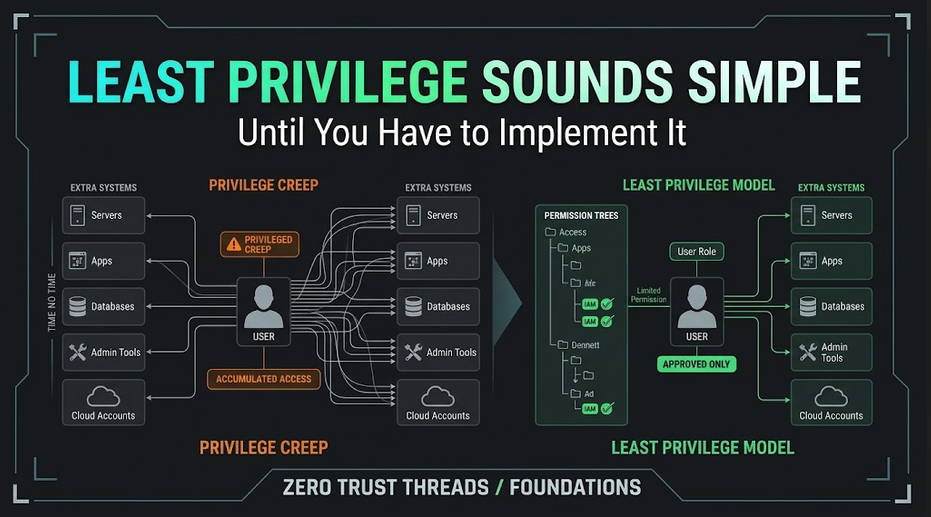
The shared identity makes it easier to give everyone the maximum privilege required by anyone in the group. Individual identities make it easier to tailor permissions.
For example:
Alice: Server administration
Bob: Log review
Charlie: Database administration
They do not necessarily need identical access.
Sometimes Shared or Group Accounts Exist for a Reason
This is not a claim that every shared or group account is automatically prohibited everywhere. Real systems may contain:
Emergency accounts
Break-glass accounts
Legacy applications
Shared operational accounts
Technical limitations
The right question is not: Does a shared account exist? It is: Why does it exist, who can use it, how is it controlled, and how is activity attributed?
The risk should be understood rather than ignored.
Break-Glass Accounts Are Different
An emergency administrator account may intentionally exist for situations where normal identity systems are unavailable. That can make sense. But such an account should be tightly managed.
Controls might include:
Restricted access
Strong authentication
Secure credential storage
Logging
Alerts when used
Regular testing
Password rotation after use
Documentation
An emergency account should not quietly become everyone's everyday administrator login.
Unique Identities Improve Investigations
Imagine an alert shows:
Privileged command executedUser:
jordan.admin
Time: 01:14
Now you can ask: Was Jordan working? Was this expected? What authentication preceded it? What else did Jordan's account do?
Compare that with:
User:
admin
The second log gives you less context.
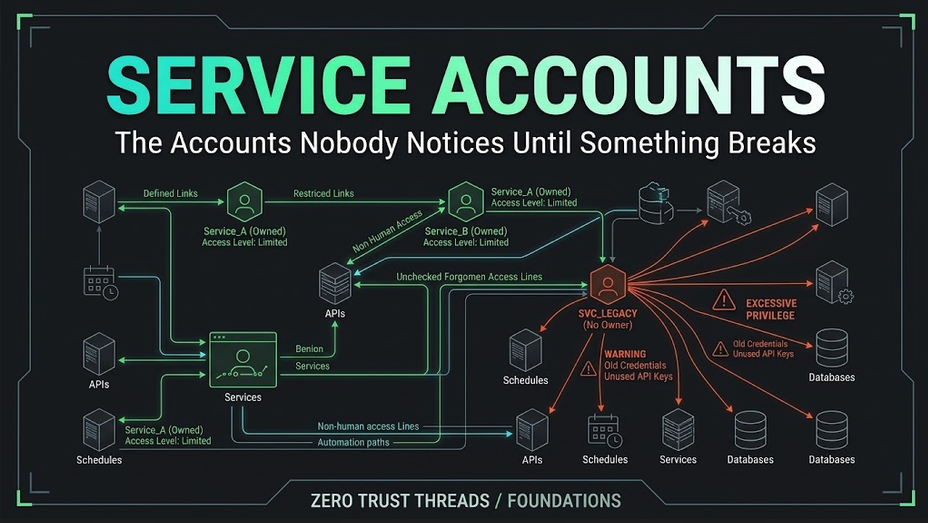
Human Accounts and Service Accounts Should Be Separated
Another problem occurs when humans and applications share credentials. A script runs under
admin
. Humans also use
admin
.
Now logs mix human activity with automated activity. That makes investigation harder. A better design often separates:
Human identities
Privileged human identities
Service identities
Application identities
Each identity should exist for a reason.
Try This in Your Home Lab
Create two Linux users:
sudo adduser alice sudo adduser bob
Log in as each user. Perform harmless actions. Then inspect
last
and
journalctl
Compare how much easier it is to understand activity when separate identities are used. Then imagine every event simply said
student
for everyone. You can immediately see why identity matters.
Key Takeaway
Shared accounts are convenient. They also weaken accountability, complicate offboarding, make credential rotation harder, and reduce the value of logs.
Unique identities help answer:
Who had access?
Who performed the action?
Who still needs access?
Security gets easier when identities actually identify something.
Verified References
NIST SP 800-171 Rev. 3 includes individual, group, temporary, system, guest, emergency, developer, and service accounts within account-management considerations. It requires account monitoring and disabling accounts when they are no longer appropriate, while noting that some group account types may be prohibited because of increased risk.
About the author
- Zero Trust Threads is a cybersecurity media and lifestyle brand focused on making cybersecurity, Linux, networking, GRC, and tech culture approachable through practical projects, real-world learning, and a little humor. Trust nothing. Learn everything.
Comments
Join the discussionNo comments yet. Be the first to comment.
Zero Trust Threads Foundations
Cybersecurity does not have to be learned all at once. Zero Trust Threads Foundations breaks down essential cybersecurity and IT concepts into approachable, practical lessons for beginners. Learn the fundamentals of HTTP security, home labs, Linux, logs, defensive security, and more while building the knowledge needed for hands-on learning.