More Alerts Don't Mean Better Security
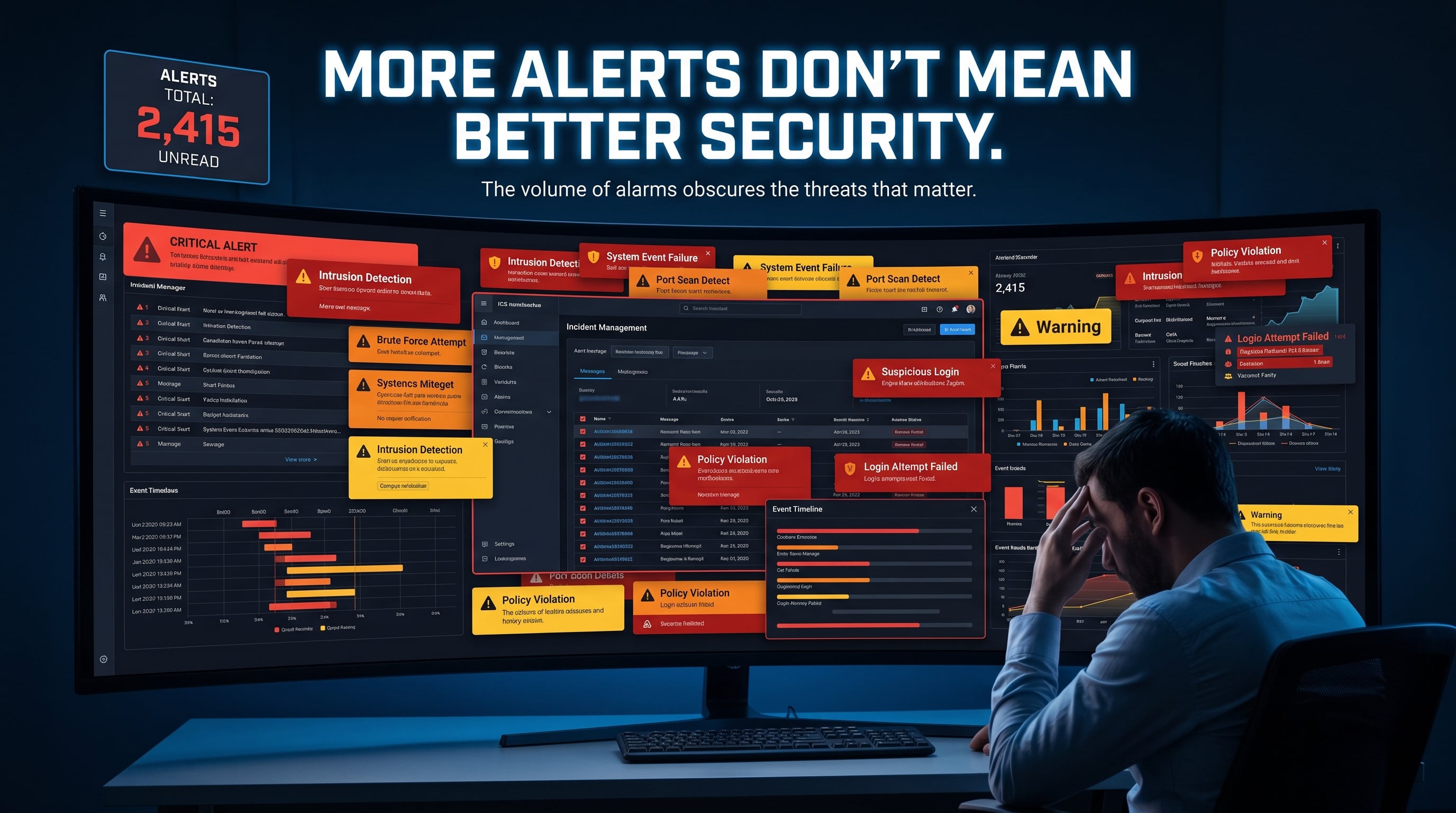
Imagine two security operations teams.
Team A receives:
20,000 alerts every day.
Team B receives:
300 alerts every day.
Which team has better security?
There is no way to know.
Alert volume does not measure security quality.
A system generating endless warnings may be highly capable.
It may also be badly tuned.
The important question is not:
How many alerts did we generate?
It is:
Did we identify the activity that actually required action?
An Alert Has a Cost
Every alert consumes something.
Maybe:
- Analyst time
- Investigation time
- Compute resources
- Storage
- Ticketing
- Escalation effort
- Attention
Attention is limited.
If everything is urgent, eventually nothing feels urgent.
That is why alert quality matters.
False Positives Are Not Just Annoying
Suppose a detection fires every time an administrator uses a legitimate management tool.
Analysts investigate.
Every time, the result is the same.
Expected behavior.
Eventually people learn:
That alert is always noise.
Then one day the same detection fires during actual malicious activity.
Will someone treat it seriously?
Maybe.
Maybe not.
Too much noise trains people to ignore the system.
That creates risk.
Not Every Anomaly Is an Incident
Systems produce unusual activity constantly.
A user travels.
A server gets updated.
A new application communicates externally.
A developer runs a script.
An administrator logs in late.
A backup transfers a large amount of data.
All of those may look unusual.
Unusual does not automatically mean malicious.
NIST guidance emphasizes the importance of understanding normal activity and establishing appropriate alerting thresholds so defenders can distinguish meaningful events from expected behavior.
The same reasoning applies broadly to security monitoring.
Context matters.
Tuning Is Part of Detection
A detection rule is not necessarily finished the day it is created.
Maybe the threshold is too low.
Maybe a legitimate application needs to be excluded.
Maybe one alert should be grouped with related activity.
Maybe an important field is missing.
Maybe severity should change based on the asset involved.
Maybe expected administrative behavior should be handled differently.
Detection tuning can reduce false positives and improve signal quality.
That is not weakening security.
That is improving the detection.
But Do Not Tune Away the Problem
There is a danger on the other side too.
An alert is noisy.
Someone disables it.
Problem solved.
Not necessarily.
The goal of tuning is not:
Make alerts disappear.
It is:
Make alerts more meaningful.
Maybe the rule needs:
- Better conditions
- More context
- Asset importance
- User information
- Time-based logic
- Correlation with another event
- A higher threshold
- A different response
Suppressing everything is not tuning.
It is blindness.
Severity Needs Context
Imagine this alert:
Five failed logins
On a public login portal, that might be routine.
Now imagine:
Five failed logins to a privileged account
followed by a successful login
from a new location
at 3:00 AM
Same basic event type.
Very different context.
Good detection systems try to include enough information to help analysts understand that difference.
Asset Context Matters
A suspicious process on a disposable test VM may have one priority.
The same process on a domain controller may have another.
A new external connection from a kiosk may be unusual.
The same connection from a developer workstation might be expected.
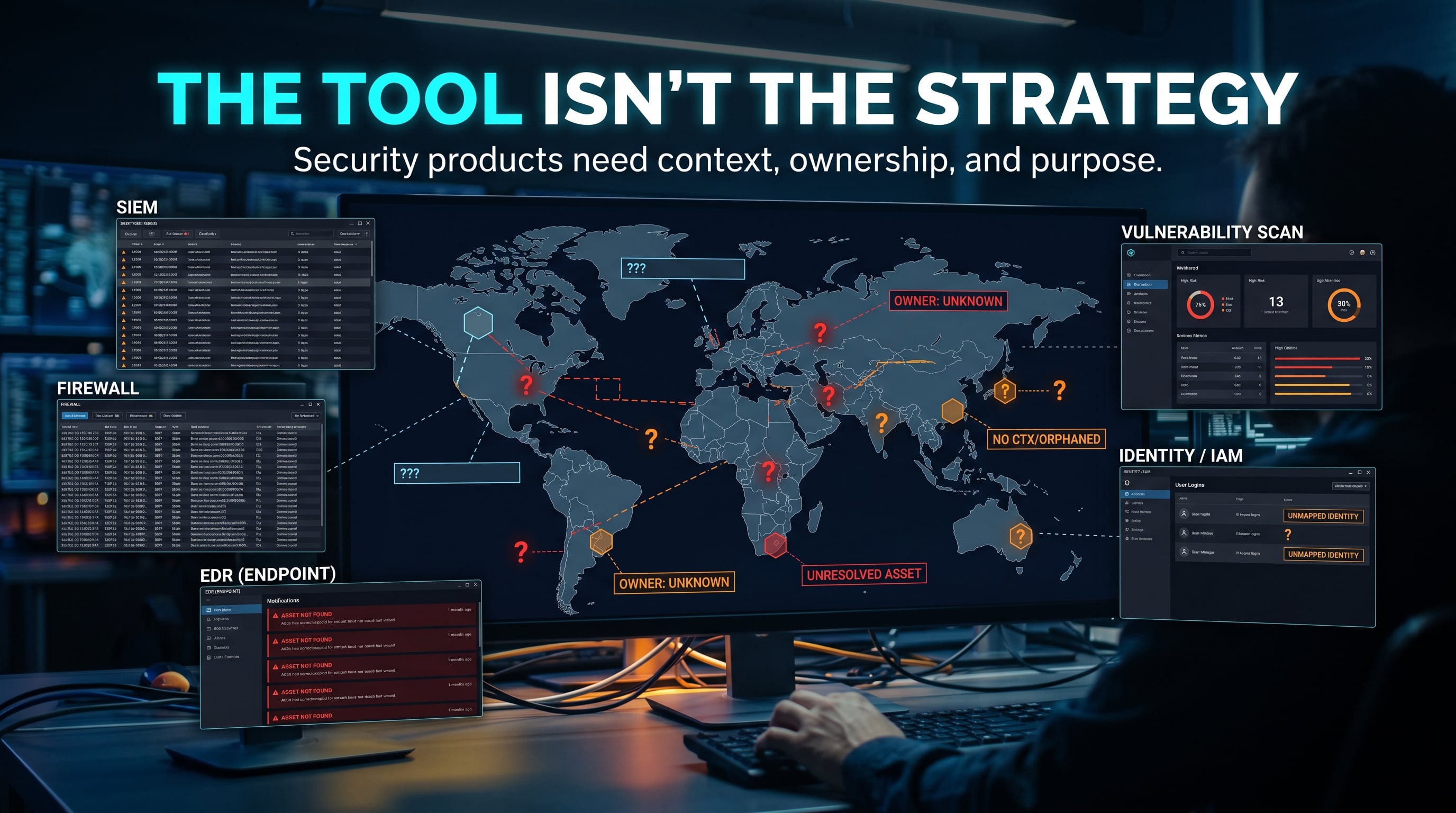
Without asset information, alerts lose meaning.
This is why detection depends on the foundational work that came before it:
- Asset management
- Identity
- Logging
- Network understanding
- Baseline behavior
Security is interconnected.
Alerts Should Lead Somewhere
Every important alert should answer:
- Who receives this?
- What information do they need?
- What should they check?
- What makes it escalate?
- What makes it close?
If nobody knows what to do when an alert fires, the detection may not be operationally useful.
A dashboard full of warnings is not a response process.
Centralized Logging Can Help Correlate Events
One alert may not tell the whole story.
Centralized logging can help defenders combine evidence from multiple systems and understand whether separate events are related.
For example:
Firewall alert
       +
Authentication event
       +
Endpoint process
       +
DNS request
       =
Much better context
Correlation can turn several weak signals into a stronger investigation lead.
A single event may be ambiguous.
Multiple related events can tell a story.
More Data Is Not Always More Visibility
This sounds contradictory.
Security teams need telemetry.
But collecting everything without purpose can create its own problems.
Huge amounts of data can become difficult to:
- Search
- Store
- Retain
- Interpret
- Prioritize
Visibility means useful understanding.
Not simply maximum volume.
Measure Alert Quality, Not Just Alert Count
A team can ask more useful questions than:
How many alerts did we generate?
For example:
- How many alerts were investigated?
- How many were true positives?
- How many were false positives?
- Which rules create the most noise?
- Which alerts repeatedly close as expected activity?
- How long does triage take?
- Which detections have no clear response?
- Which important incidents were missed?
Those questions tell you more about whether the detection program is useful.
A Noisy Detection Has a Lifecycle Too
Imagine a rule generates 500 alerts every day.
Most of them are benign.
That rule should not simply be accepted forever.
A useful process might look like:
Detection fires
      ↓
Analysts review results
      ↓
Noise is identified
      ↓
Rule is tuned
      ↓
Results are reviewed again
      ↓
Detection improves
Detection engineering is iterative.
You learn from how a rule behaves in the real environment.
Try This in Your Lab
Create a simple rule for yourself.
Every time you see something unusual in your lab, write:
Observation:
What happened?

Expected?
Yes / No / Unsure

Context:
What system?
What user?
What process?

Evidence:
What logs or commands support the conclusion?

Action:
Ignore / investigate / change configuration
You are practicing the same basic idea behind good alert triage.
Turn noise into context.
Go One Step Further
Keep a small table of repeated events.
For example:
| Event | Frequency | Expected? | Action |
|---|---|---|---|
| Failed SSH login | Occasional | Yes during testing | No action |
| Package update connection | Daily | Yes | No action |
| Unknown listening port | New | Unsure | Investigate |
| New privileged user | Rare | No | Investigate immediately |
Now you are beginning to build your own understanding of normal behavior.
That makes future anomalies easier to interpret.
The Best Alert Is Actionable
A useful alert should help someone answer:
- What happened?
- Where?
- When?
- Who or what was involved?
- How confident are we?
- Why does this matter?
- What should I investigate next?
The closer the alert gets to those answers, the more useful it becomes.
Key Takeaway
More alerts do not automatically mean better security.
Better detection means finding meaningful activity with enough context for someone to make a decision.
Tune noise.
Preserve useful visibility.
Understand normal behavior.
Correlate evidence.
Prioritize what matters.
The goal is not to make the dashboard louder.
It is to make the important signal easier to hear.
Verified References
NIST SP 800-82 Rev. 3: Guide to Operational Technology Security
Discusses monitoring, anomaly detection, alert thresholds, and the importance of understanding normal behavior so defenders can reduce nuisance alarms and better interpret events.
https://csrc.nist.gov/pubs/sp/800/82/r3/finalNIST Cybersecurity Framework 2.0
Includes continuous monitoring, event analysis, and detection activities within the Detect function.
https://www.nist.gov/cyberframeworkCISA Cybersecurity Performance Goals
Recommends centralized logging, monitoring, and security event visibility as part of foundational cybersecurity practices.
https://www.cisa.gov/cybersecurity-performance-goals
This article is intended for educational purposes. Detection rules, alert thresholds, and monitoring strategies should be tuned according to the normal behavior, risk, and operational requirements of the environment where they are used.