Vulnerability, Threat, and Risk Are Not the Same Thing
Cybersecurity has a vocabulary problem.
Words that have specific meanings are often used interchangeably in casual conversation.
Three of the most common are:
Vulnerability
Threat
Risk
They are related.
They are not the same thing.
Understanding the distinction will make many other cybersecurity concepts easier to understand.
What Is a Vulnerability?
NIST defines a vulnerability as a weakness in a system, security procedure, internal control, or implementation that could be exploited or triggered by a threat source. NIST Computer Security Resource Center
The important word is:
Weakness.
A vulnerability might exist in:
Software
Configuration
Security procedures
System design
Access controls
Other implementations
For example, imagine an internet-facing application contains a software flaw that could permit unauthorized access under certain conditions.
The weakness is the vulnerability.
What Is a Threat?
A threat is different.
NIST describes a threat as a circumstance or event with the potential to adversely affect operations, assets, individuals, or other entities through actions such as unauthorized access, destruction, disclosure, modification, or denial of service. NIST Computer Security Resource Center
A threat represents something capable of causing harm or contributing to an adverse event.
Threats are not limited to stereotypical "hackers."
Depending on the risk context, threat events or sources can involve malicious actors, human error, environmental events, technical failures, or other circumstances.
What Is Risk?
Risk brings the situation together.
NIST commonly defines risk as a measure of the extent to which an entity is threatened by a potential circumstance or event, typically considering both the adverse impact and likelihood of occurrence. NIST Computer Security Resource Center
That means risk is not simply:
There is a vulnerability.
You also need context.
What could happen?
How likely is it?
What would the impact be?
What controls already exist?
Those questions influence how risk is understood and managed.
A Simple Example
Imagine a company operates an application that contains a known vulnerability.
That is the weakness.
An attacker capable of exploiting that weakness represents part of the threat context.
The potential consequences and likelihood surrounding exploitation contribute to the risk.
The terms describe different parts of the situation.
Another Example: An Unlocked Door
Physical security gives us an easy analogy.
Imagine a business has a side door that does not lock properly.
Vulnerability: The broken lock.
Threat: A circumstance or actor capable of taking advantage of that weakness.
Risk: The potential for harm considered in context, including likelihood and impact.
Now change the context.
Suppose the broken door is inside another heavily controlled area with guards, monitoring, and additional locked barriers.
The vulnerability still exists.
But the overall risk may be different because other controls and circumstances affect likelihood and impact.
This is why:
Vulnerability does not equal risk.
Not Every Vulnerability Has the Same Risk
Imagine two systems have the same software vulnerability.
System A is isolated in a laboratory and contains no sensitive information.
System B is internet-facing and supports an important business process.
The technical vulnerability may be identical.
The risk context is not.
Organizations therefore should not make security decisions solely by counting vulnerabilities.
Prioritization requires context.
Controls Change Risk
Security controls can affect the likelihood or impact of adverse events.
Examples could include:
Network segmentation
Multi-factor authentication
Access controls
Monitoring
Patching
Backups
Encryption
Application allowlisting
A control does not necessarily make risk disappear.
It can help reduce or manage it.
That is one reason cybersecurity is not simply a hunt for perfect security.
Organizations make decisions about risk.
Risk Is Not Just a Technical Problem
This is especially important for beginners interested in GRC.
Technical teams may identify vulnerabilities.
Security teams may analyze threats.
But organizations must ultimately understand what those conditions mean to their operations.
Questions might include:
What systems are affected?
What information could be exposed?
Could operations be disrupted?
What would recovery require?
What controls already exist?
How likely is the scenario?
What would the impact be?
Those are risk questions.
Why This Matters for Cybersecurity Careers
Whether you eventually work in:
SOC operations
Incident response
Vulnerability management
Cloud security
GRC
Penetration testing
Security engineering
System administration
you will encounter these concepts.
Using the terminology correctly helps you communicate clearly.
Instead of saying:
"We found a risk."
you may need to explain:
"We identified a vulnerability that could be exploited under these conditions, creating this potential impact."
That is a much more useful security conversation.
A Simple Mental Model
When you get confused, remember:
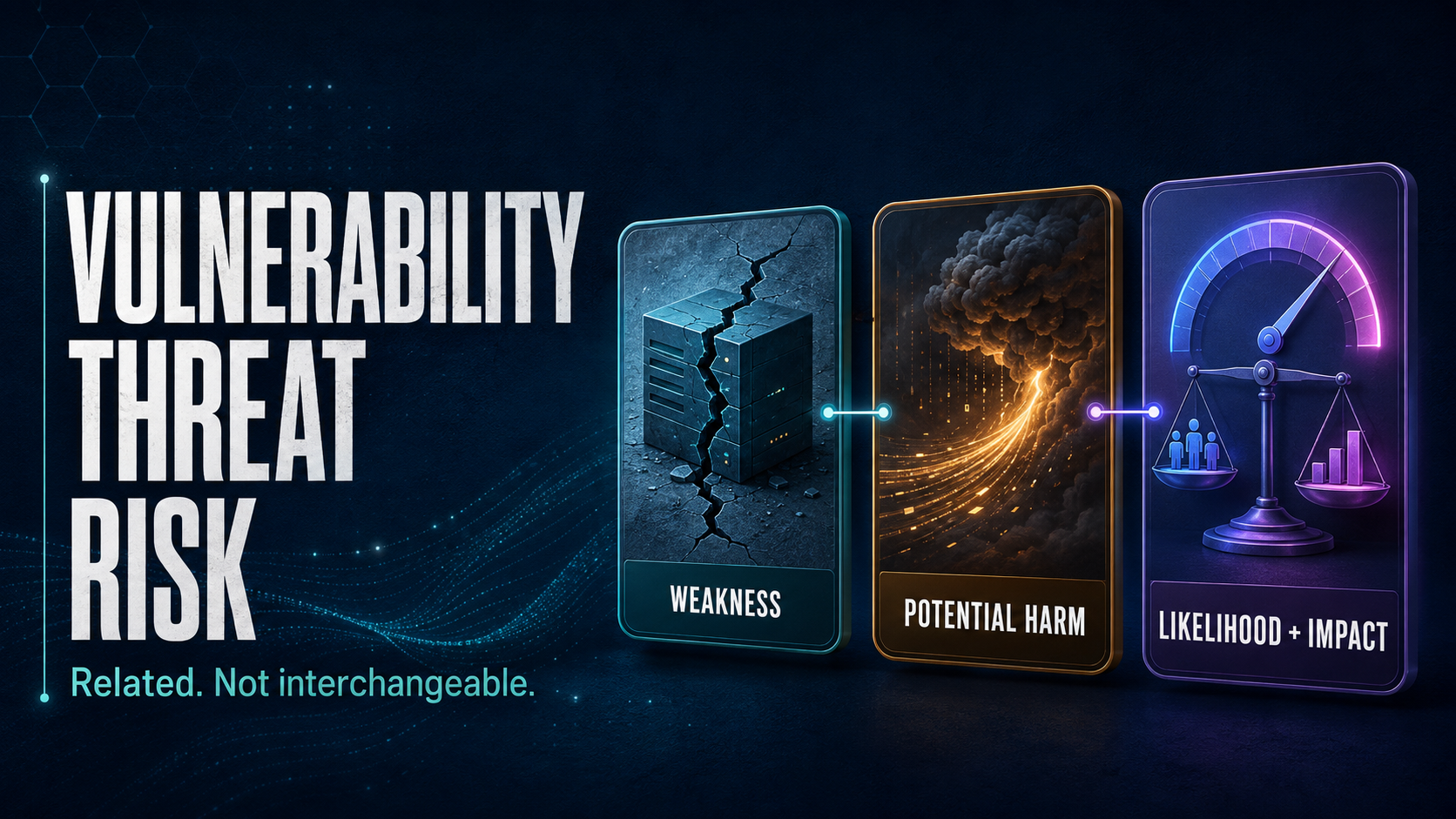
Vulnerability = weakness
Threat = potential source or circumstance of harm
Risk = potential harm considered with likelihood and impact
This is intentionally simplified.
Formal risk assessments can be much more detailed, and different frameworks may express the relationships differently.
But this mental model gives beginners somewhere reliable to start.
Security Is About Context
One of the biggest lessons in cybersecurity is that context matters.
A vulnerability does not automatically mean catastrophe.
A threat does not automatically mean compromise.
A security control does not automatically eliminate risk.
Cybersecurity involves understanding systems, weaknesses, threats, controls, likelihood, consequences, and organizational priorities.
That is why good security requires more than running a scanner.
Tools can give you data.
Humans still need to understand what that data means.
Key Takeaway
Vulnerabilities, threats, and risks are connected but distinct concepts.
A vulnerability is a weakness.
A threat has the potential to cause harm or exploit a weakness.
Risk considers the potential adverse consequences and likelihood in context.
Once you understand those distinctions, vulnerability management, threat modeling, risk assessment, and GRC all become easier to understand.
Do not just memorize the definitions.
Practice applying them to real scenarios.
That is where the learning happens.
References
NIST Vulnerability Glossary
NIST Threat Glossary
NIST Risk Glossary
NIST Risk Analysis Glossary